ORIGINALLY RELEASED AS THE JUNE 2026 EDITION OF THE HERE & NOW NEWSLETTER (CLICK HERE TO SUBSCRIBE)
Written by Matt Warren, LMHC MDiv (Executive Director, Senior Clinician)
Perfectionism is one of those mental health terms that people throw around all too casually and even use as a badge of honor. “Ugh, I’m such a perfectionist,” he says, as he secretly hopes everyone notices and admires his attention to detail, exactitude, and overall standard of excellence (I may or may not be speaking from experience here…).
And yet, for those who know the real struggle involved with it, perfectionism is actually a crushing weight and an unrelenting burden to carry through life (even if it’s mostly self-inflicted). With it comes near constant anxiety, restlessness, insecurity, and exhaustion. Because of it we might avoid situations, procrastinate on tasks, and spiral into harsh self-criticism, which then creates additional stress and hardship for ourselves. As perfectionists we will waste innumerable hours of our lives double/triple/quadruple checking everything we do to remove all possible blemishes and then overanalyzing every little bit of feedback received whether positive or negative.
Does this paint the picture clearly enough? Perfectionism is more trouble than its worth, but by its very nature can feel quite impossible and even perilous to try and change within ourselves.
This is because of its deep connection to shame. We might expect perfectionism to be tied to an overly high standard for oneself, but in reality it is more often tied to an overly low and worthless view of our true self, that is, the self that exists beneath all of our perfectionistic efforts.
Somewhere along the way, we have come to believe that our place in the world and our value to others is based on our ability to maintain a certain level of perfection (can also be translated as: excellence, precision, righteousness, competence). This belief then tells us that we will lose our social value if we don’t constantly maintain this level of perfection that we have established for ourselves. Which in turn tells us that we ultimately have less value as a person apart from this performance of perfection. Underneath all of this, we believe that our true self, without the sheen of perfectionism to protect us, is actually quite value-less and at risk of being abandoned and unloved. So to guard against that feared reality, we must stay vigilant - blowing people away and getting it exactly right every…single…time. And on and on the cycle must continue.
So what will finally help us put down the heavy and relentless burden of perfectionism?
The Gospel
First and foremost, the radical truth of the Gospel invites us to do so. The Gospel assures us that God’s love and favor are entirely unmerited. Our worth, our value, our belonging, our security are all freely given to us and inherited by us through Christ. Striving for perfection does nothing to change that one way or the other. There is nothing more that can be earned or achieved by all of our striving beyond what Christ has already done for us. There is no more love to be won than what God already has for us simply by being His children. Seen from this perspective, perfectionism is mostly a waste of time and energy as we exhaust ourselves in trying to obtain something that is already ours in Christ.
Relationships
In addition, authentic relationships with others remind us of this same truth. When we risk letting someone see us as we actually are - the “rough draft” version of ourselves rather than the polished and hyper-edited final version - we have the opportunity to experience something transformative. We open ourselves up to meaningful connection rather than mere praise or criticism. Our true self can be met with acceptance rather than the endless rollercoaster of approval or rejection. Being known without the performance, and loved anyway, is a tangible echo of the Gospel. This is why authentic vulnerability within trusted relationships is not optional for the perfectionist; it is part of the cure.
Practicing Imperfection
As long as we keep performing in the same old ways, we never get to find out whether the performance is actually what's holding everything together. The only way to break the cycle is to interrupt the pattern, to risk being imperfect and watch what actually happens. Most of the time, the catastrophe we feared doesn't come, and little by little, those underlying false beliefs begin to lose their power.
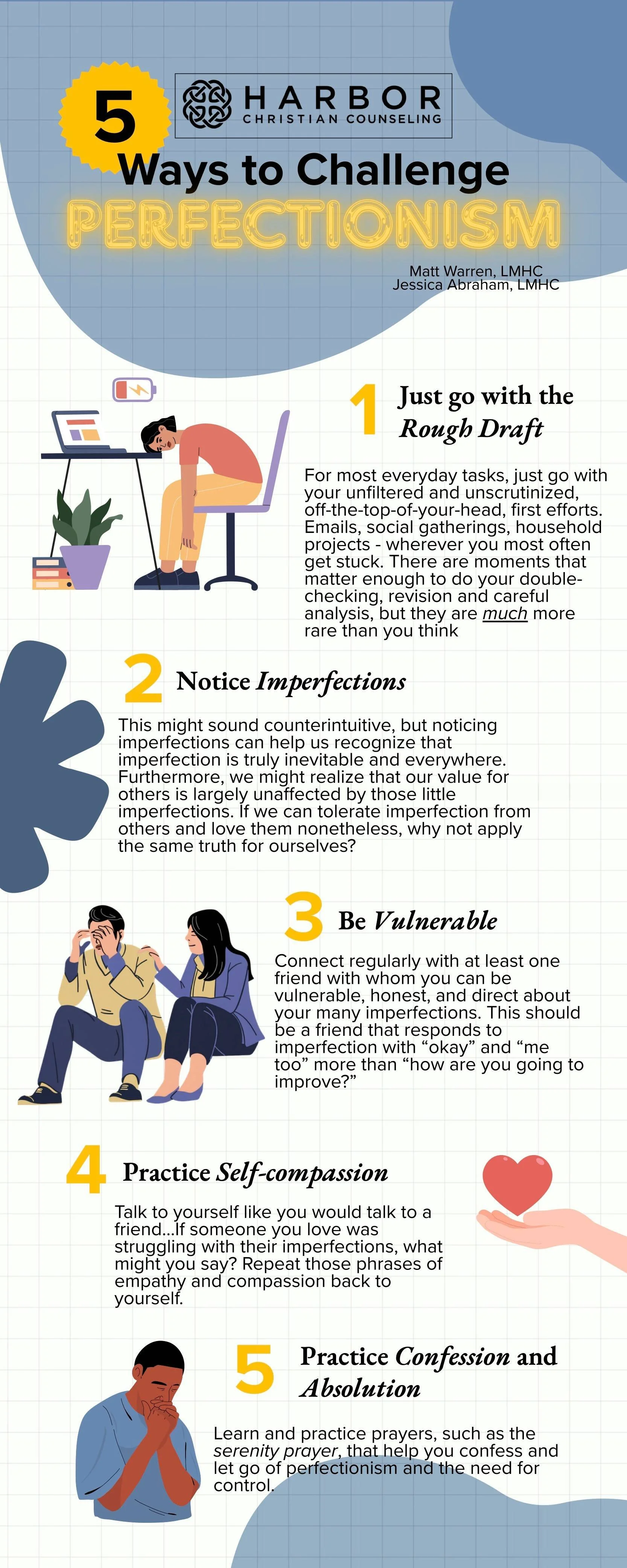
The infographic below suggests a few specific ways to put this into practice and lean into imperfection. It might feel like a huge risk, but that's the point! And what you are likely to find on the other side is a lighter and freer way of being and a stronger grasp of just how fully loved you are without having to earn it.