

ORIGINALLY RELEASED AS THE JULY 2026 EDITION OF THE HERE & NOW NEWSLETTER (CLICK HERE TO SUBSCRIBE)
Written by Day Marshall Day Marshall, LMHC (Senior Clinician, Site Director HCC Oregon)
Often in the counseling office, I find that we as Christians can regard the word ‘assertive’ as a negative trait. For some people it seems to contradict an idea of meekness or gentleness. I often hear the phrase ‘turn the other cheek’ used as an example of a teaching that contradicts assertiveness as a Christlike characteristic.
However, assertiveness is the healthiest, most loving, and I would argue, most Christlike way to communicate. Here’s why:
Non-Communication (Passive)
"I have needs, but I do not communicate them." This is sometimes regarded as a positive trait in people. The idea that a person does not express directly what is important to them, or their preferences, can be interpreted as that person being ‘easy going’ or ‘a real people person’. However, not communicating needs and opinions often leads to high levels of depression, anxiety, and a diminished a sense of wholeness in the passive communicator.
Passive-Aggressive Communication
"I am not going to tell you what I want (i.e. passive) but I will act out toward you in a way that lets you know I am not happy, and those actions will be done in frustration or anger (i.e. aggressive)." This tends to be one of the most frequently used means of communication. Some cultural expectations that tell us we ought to be pleasant, agreeable, and not complain ultimately foster an unhealthy passivity that builds up to acting out to get needs met. This common form of unhealthy communication leads to conflict, confusion and frustration in relationships.
Aggressive Communication
"Only my needs matter." On the other side of our communication style spectrum, aggressiveness demands its own way. Aggressive communication attempts to intimidate in order to get needs met. This comes out in relationships as rigidity or inflexibility. It can be extremely self-centered, and does not consider others’ circumstances, opinions, or needs. It frequently disregards other perspectives as being, at best, not as important, and at worst, irrelevant altogether.
Assertive Communication
"I will tell you what my needs are, ask for your buy in, and be open to hearing your perspective." Assertiveness is the nice, middle ground of our communication spectrum. It respects one's own needs and desires, while also respecting others’ needs. It clearly communicates need and gives other people the opportunity to give feedback, disagree, or agree with your request.
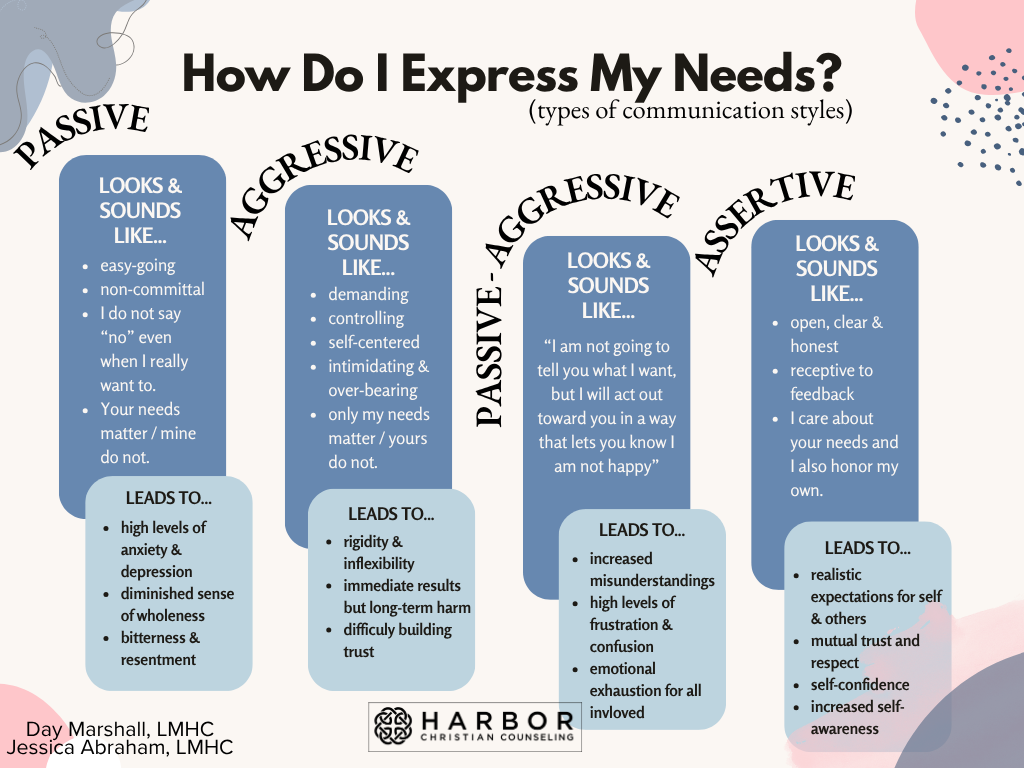
Consider how assertive communication looks a lot like how Jesus communicated. Assertiveness opens the door for conversation. It does not demand its way. It invites questions. It is loving and collaborative. It is honest and transparent about needs, longing, and emotions. It asks for others’ perspective, ideas, and buy-in for making the situation better. Assertiveness is kind, clear, and keeps the lines of communication open. Assertiveness communicates and respects boundaries and allows relationships to be secure and healthy.
Becoming more assertive in our communication style can take practice and patience. In counseling sessions with clients who are improving their assertiveness skills, I always see improved relationships, even when that improvement is a bit of a process of successes and setbacks. New behaviors take time to develop, but in this case, the work is well worth the payoff!