

Written by Matt Warren, LMHC MDiv (Executive Director, Senior Clinician)
We are increasingly aware of the damage caused by mental health stigma - that is, those cultural beliefs and attitudes that marginalize, malign, distort, and dismiss the experience of mental illness. We know that stigmas are based on misperceptions, stereotypes, unhealthy social pressures, and just plain carelessness. We know that they create shame, denial, isolation, prejudice, and hopelessness along with overall worsened symptoms and decreased engagement in treatment.
Of greater concern, at least for us as Christian counselors, is the unique forms of mental health stigma that can exist within Christian culture. Being directly associated with something as sacred as our shared faith, these forms of stigma produce even deeper layers of confusion and shame for those struggling with mental health. This occurs despite the fact that mental illness is just as prevalent among Christians as it is within the general population and is just as prevalent among church leaders as among any other member of a congregation. For something that is exceedingly normal, why do we as Christians so often treat it as something that makes us unfit or unworthy?
The graphic below outlines some of the most prevalent stigmas in Christian culture related to mental health. Perhaps you have been negatively affected by one or more of these false beliefs. Perhaps you might even hold to some of them yourself. Let’s take a moment to reconsider.
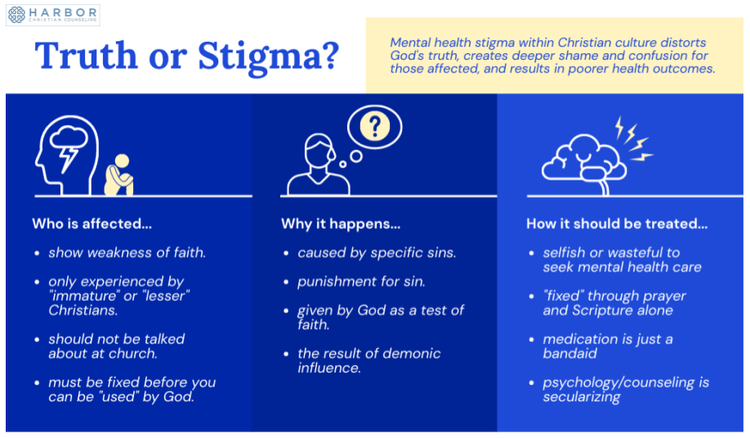
As a Christian counselor but also as someone who cares about the Church, mental health stigma within Christian culture is concerning for a few reasons:
1) It means that Christians become prone to poorer health outcomes and decreased utilization of effective and appropriate treatment options.
2) It means that the Church becomes sidelined from the complex realities of mental health in the lives of its community and thus less likely to serve as a place where people can express vulnerability and receive support where they really need it.
3) It fundamentally misrepresents the truth of who God is, how He made us, and how He extends grace and mercy to us in our deepest needs.
Because the truth is that God created us as human beings, and as human beings we bear the image of God yet are also fundamentally and without exception finite, dependent, and fallible. As human beings, we are scarred inside and out by sin, yearning for restoration and experiencing glimpses of it now in part through Christ but not yet in full. To be human is to be needy and to struggle - in body, in mind, and in spirit. And to provide for those needs, God has given us Himself and His Word along with the common graces of medicine, relationships, and wisdom, to name a few.
Mental health is a reality of our human condition. As such, it is normal for Christians to struggle with mental health. It is not a reflection of spiritual maturity or a test of righteousness. It is not something to be spiritualized or dismissed or hidden as though unbecoming of a “good” Christian. Mental health is a normal part of our Christian experience, and God has given us all manner of ways to receive care for our mental health needs.
Normalization is the antidote to stigma. So let’s put away that which is stigma and put on that which is the truth - the normalizing, compassionate, grace-filled truth of who God made us to be.