

ORIGINALLY RELEASED AS THE MAY 2026 EDITION OF THE HERE & NOW NEWSLETTER (CLICK HERE TO SUBSCRIBE)
Written by Jessica Abraham, LMHC (Senior Clinician)
How do you spend your mornings and evenings? Do you find yourself connecting with loved ones or spending time on a hobby? Or do you find yourself reaching for your phone and before you know it, you’ve spent hours scrolling from one video or article to the next? If this is you, you’re engaging in what is known as “doomscrolling,” and you are not alone. Doomscrolling and information overload have become the “new normal” of our world today.
On a daily (if not hourly) basis, we are bombarded with images and sounds of all kinds. Through various forms of media - be it podcasts, videos or articles - we are constantly being overloaded with information about ourselves, other people, and the world around us. Research indicates that the average person consumes around 74 GB of data per day. This would equate to watching roughly 16 movies a day! Not only are we consuming significantly more than generations past – the average rate of data consumption is also continuing to increase by about 5% a year.
If doomscrolling and information overload have become the norm, what if we paused to consider how this impacts us?
The reality is, doomscrolling and information overload has its tentacles in every facet of our lives. From a mental health perspective, doomscrolling triggers the reward pathway in our brain, creating a dopamine “hit” regardless of the content we are watching. Flipping back and forth from horrific national and global news to a quick video about the latest trend within a matter of minutes creates emotional whiplash and triggers the part of our brain (the amygdala) that is in charge of our fight-flight-freeze responses. This often leaves us feeling overwhelmed, confused, and more anxious, which in turn results in continuing to scroll in hopes of another dopamine “hit.” And the vicious cycle continues…
Here are some other ways that doomscrolling and information overload impact us:
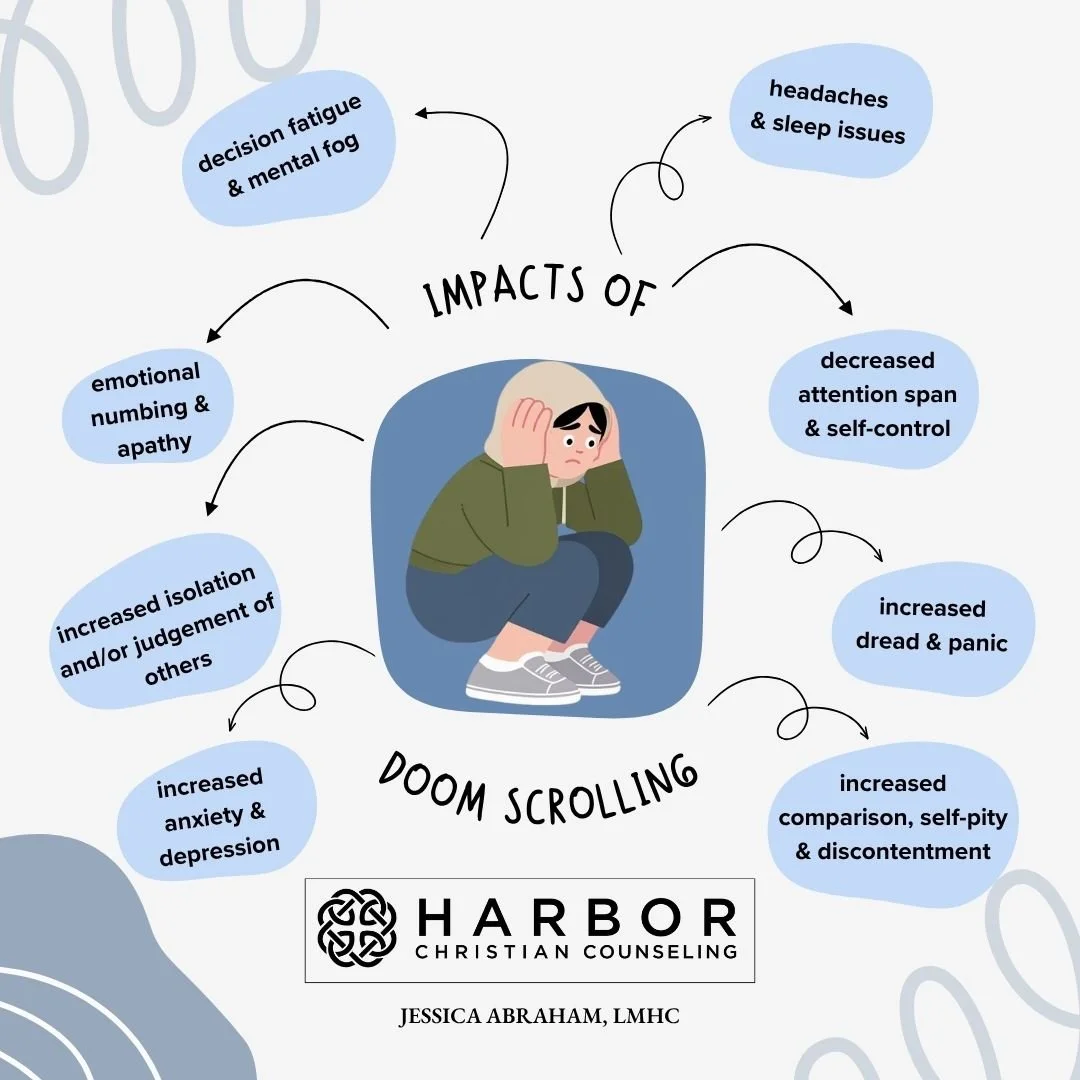
Do you find yourself resonating with any of these symptoms? Recognizing the negative impacts of doomscrolling is not about judging ourselves or others, but rather about increasing self-awareness and empathy for those around us who might be similarly struggling. We can’t change what we are not aware of, and we also cannot properly engage with the realities of this world if we aren’t taking time to actually process the information we are reading and watching.
As you reflect during the weeks to come, consider this “PEACE” acronym to implement boundaries and practical coping skills when engaging with information online:
Pause & Pray: Take some time to pause and pray before and after you open the news or social media. Before you scroll, ask God to protect you from apathy, comparison, judgment, complacency and dread. Afterwards, take time to lament the heaviness of this world and process whatever emotions were stirred up in you (Romans 12:15; Luke 19:41-44).
Examine your heart: What is your heart posture when engaging with information online? Is who you are following or what you are watching edifying? Is it in line with your values? Take time to reflect on what your purpose and posture is before you scroll or swipe (Psalm 139:23-24).
Apply & Act: Access to information is not inherently a bad thing, but what we do with it matters (Isaiah 1:17; 1 John 3:18). Who might God be inviting you to pray or show up for? What growth area might God be inviting you to work on?
Create limits: Our brains are quick to register environmental cues, therefore it is important to protect spaces that are meant for rest (such as our bed) so that they don’t trigger anxiety, dread, or panic (Mark 6:31). Set boundaries by creating digital-free zones in your home or limiting your time on certain apps. Turn off notifications and/or delete certain apps for a season and pay attention to the impacts this has on your mental, physical and spiritual health.
Engage meaningfully: Whether it’s on a video call or in-person, the more we connect with real people rather than a profile, the more room and opportunity for empathy, compassion and understanding for one another (Ephesians 4:2).
Remember: the goal is not to avoid the news nor to over-consume, but rather to be thoughtfully informed and reliant on our true source of peace, justice, comfort and joy - Jesus Christ.